
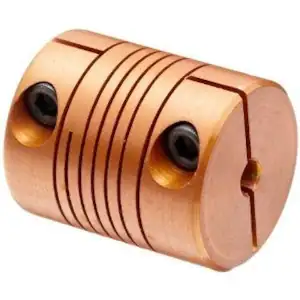
Couplings for CNC and 3D Printing Motion Systems: What to Look For Most CNC machines and 3D printers connect a stepper or servo motor to a leadscrew or ballscrew with a flexible beam coupling, not a jaw, grid, or rigid coupling. Motion axes need near-zero backlash and the ability to transmit rotation one-to-one for accurate […]

08
Oct
Oct
U-Joint Series Numbers Explained: Matching 1310/1330/1350 to Your Driveshaft A “1310,” “1330,” or “1350” series number tells you the bearing cap diameter and overall cross size of a universal joint — not the vehicle it fits. Two joints with the same series number can still differ in cap-to-cap width, retention style (snap ring vs. U-bolt), […]
Grid Couplings vs Chain Couplings: Which Needs Less Maintenance? Chain couplings are generally the lower-maintenance choice of the two: they use fewer precision parts, tolerate a wider lubrication interval before performance suffers, and are cheaper to service when you do get to them. Grid couplings aren’t high-maintenance by industrial standards, but their spring-steel grid runs […]
25
Sep
Sep
Jaw Coupling Spider Materials Compared: Polyurethane vs Hytrel vs Bronze vs NBR The spider is the part of a jaw coupling that actually wears out — and the material it’s made from determines how much torque it can handle, how hot it can run, and how long it lasts before you’re replacing it again. Polyurethane, […]
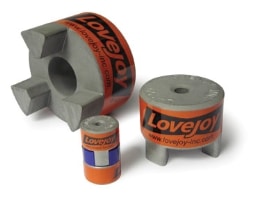
Lovejoy L-Series Jaw Coupling Cross Reference Guide The Lovejoy L-Series (L070 through L225) is the most widely copied jaw coupling dimensional standard in power transmission — which is exactly why cross-referencing one correctly matters. Because the physical envelope (bore range, outside diameter, hub length) is common across manufacturers, a coupling stamped with a different brand […]
Jaw Coupling vs Disc Coupling: Which Do You Need? A jaw coupling uses a replaceable elastomeric spider to absorb shock and handle minor misalignment, while a disc coupling uses a stack of thin metal discs to transmit torque with near-zero backlash and no wearing parts. Choose a jaw coupling for general-duty machinery where cost and […]
How to Measure Coupling Bore Size Coupling bore size is the inside diameter of the coupling hub where your shaft inserts, and it needs to match your shaft diameter within the manufacturer’s stated tolerance — not just be “close enough.” Measure the shaft’s actual diameter with calipers at multiple points, not the coupling’s existing bore, […]
14
Aug
Aug
Best Couplings for Servo Motors Beam (helical) and disc couplings are the two best choices for most servo motor applications, because both deliver the zero-backlash, high torsional stiffness performance precision motion control demands. Beam couplings suit lighter loads and tighter budgets — encoders, small CNC axes, 3D printer motion systems. Disc couplings step up for […]
Understanding Coupling Misalignment: Angular, Parallel, and Axial Shaft misalignment comes in three forms — angular (shafts meet at an angle), parallel/offset (shafts run parallel but off-center), and axial (shafts move toward or away from each other along their centerline). Almost every real-world installation has some combination of all three, which is exactly why flexible couplings […]
How to Measure Coupling Bore Size (Without Guessing Wrong) Bore size is the diameter of the hole in a coupling hub that the shaft slides into — and it’s the single most common reason a coupling order gets returned. Measure your shaft with a digital caliper at the point where the coupling will sit, not […]