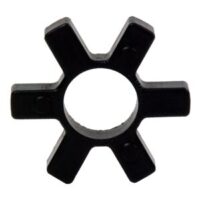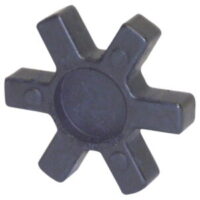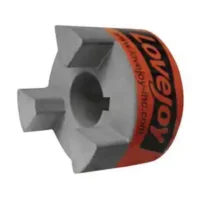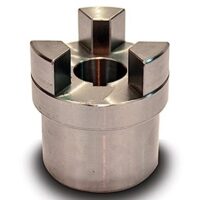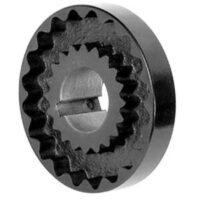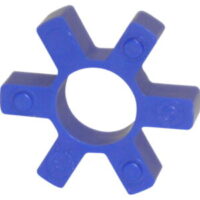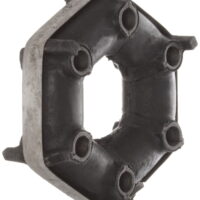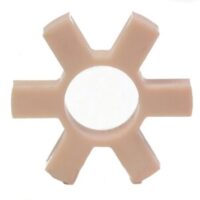
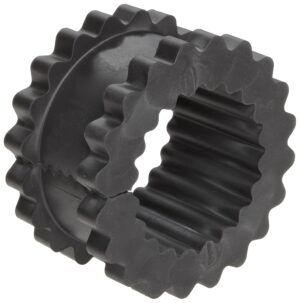
Martin 5JEMS Quadraflex Sleeve is the elastomeric sleeve insert for a Martin Quadraflex coupling — the wear part that absorbs shock and vibration, sold separately for maintenance replacement without disturbing the hubs.
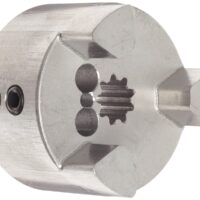
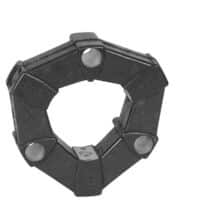
Quad-flex (Quadraflex) couplings are a flexible flange-style design that connects two shaft ends through a molded elastomeric insert with four lobes, sandwiched between two hubs or flanges. Unlike rigid couplings, the elastomeric element flexes to absorb shock loads and vibration while still transmitting torque efficiently between the driving and driven shaft. This design tolerates a moderate amount of angular and parallel misalignment without transmitting that stress into the connected equipment’s bearings, which is the main reason it’s chosen over a rigid coupling in general industrial and agricultural drivetrains.
Confirm the bore diameter matches your shaft size, including keyway width and depth if the hub is keyed rather than clamped. Check the coupling’s rated torque against your application’s peak (not average) load — elastomeric inserts are typically rated for continuous torque with a service factor built in, so undersizing shortens insert life fast. Note the maximum allowable misalignment (usually listed as angular degrees and parallel offset in mm/inches) and don’t rely on the coupling to correct a poorly aligned shaft. Also check maximum RPM and, if the application runs hot or in an oily environment, the elastomer’s temperature and chemical resistance.
Quad-flex couplings are common on agricultural PTO drivetrains, pumps, small compressors, fans, and general-purpose industrial machinery where moderate shock loads and some misalignment tolerance are expected. They’re a frequent replacement choice on farm and mining equipment because they’re simple to service and don’t require lubrication, unlike gear couplings.
This is the 5JEMS size in Martin’s Quadraflex family. If your application’s peak torque exceeds this size’s rating, or you need a larger bore, step up to the next size — check both bore capacity and torque rating before sizing up, since they don’t always scale together.