Best Couplings for Servo Motors
Table of Contents
Beam (helical) and disc couplings are the two best choices for most servo motor applications, because both deliver the zero-backlash, high torsional stiffness performance precision motion control demands. Beam couplings suit lighter loads and tighter budgets — encoders, small CNC axes, 3D printer motion systems. Disc couplings step up for higher torque and higher-speed servo drives where stiffness and repeatability matter most. Jaw couplings, by contrast, are a poor fit here — their elastomeric insert introduces backlash that servo systems can’t tolerate.
What Makes Servo Applications Different
Servo motors are built for precision positioning, not just raw power transmission. Every bit of backlash or torsional windup in the coupling between the motor and the load shows up as positioning error, overshoot, or “hunting” in a closed-loop control system. That’s the opposite of what a general-purpose coupling like a jaw or gear coupling is optimized for — those types are built to absorb misalignment and shock, often at the cost of some backlash or compliance.
For servo work, the priorities flip: minimal or zero backlash, high torsional stiffness (so torque transmits instantly, not with a lag), and enough flexibility to handle the small misalignments that are unavoidable even in a well-installed system.
Coupling Types That Work for Servo Motors
Beam (Helical) Couplings
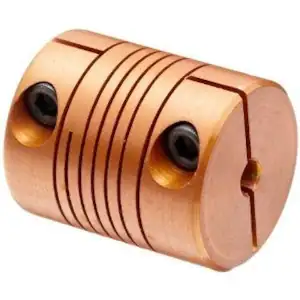
Machined from a single piece of aluminum or stainless steel with a helical spiral cut, beam couplings flex along that cut to absorb angular, parallel, and axial misalignment while maintaining zero backlash. They’re compact, lightweight, and the most common choice for encoders, small stepper and servo drives, and light-duty CNC axes.
A solid example for small-frame servo and stepper motors is the Ruland PSR18-6-5-A set screw beam coupling — polished aluminum, 3/8″ to 5/16″ bore combination, rated for 54 lb-in of torque, which covers a large share of light industrial and desktop CNC servo setups.
Disc Couplings
Disc couplings use a stack of thin stainless steel discs to transmit torque while flexing to accommodate misalignment — no elastomeric element, no backlash, and higher torque capacity than a beam coupling of comparable size. They’re the step up when a servo application needs more torque, higher speed, or longer service life under continuous duty than a beam coupling can deliver.
Bellows Couplings
Similar in spirit to beam couplings but using a formed metal bellows instead of a machined spiral, bellows couplings offer excellent torsional stiffness with very low inertia — useful in high-acceleration, low-torque instrumentation and encoder applications where minimizing rotating mass matters as much as backlash.
What to Avoid: Jaw and Elastomeric Couplings
Jaw couplings are excellent for general industrial power transmission — pumps, compressors, fans — because their elastomeric spider absorbs shock and vibration. That same compliance is a liability in servo applications: it introduces windup and backlash that directly translates into positioning error. Reserve jaw couplings for non-precision drives and use beam, disc, or bellows couplings for anything running in closed-loop servo control.
Comparing the Options
| Type | Backlash | Torsional Stiffness | Torque Range | Best Use Case |
|---|---|---|---|---|
| Beam / Helical | Zero | Moderate | Low–Moderate | Encoders, small servo/stepper axes, desktop CNC |
| Disc | Zero | High | Moderate–High | High-speed, high-torque servo drives |
| Bellows | Zero | High | Low | Low-inertia, high-acceleration instrumentation |
| Jaw / Spider | Some (elastomer) | Low | Moderate–High | General industrial — not for precision servo work |
Sizing Checklist for a Servo Coupling
- Bore size on both ends — servo motor shaft and driven-side shaft are often different diameters; confirm both before ordering. See our guide on measuring coupling bore size if you’re unsure.
- Peak torque, not just running torque — servo systems can see torque spikes well above steady-state running torque during acceleration; size to the peak, not the average.
- Maximum RPM — beam and disc couplings both have speed limits that drop as coupling size increases; check the manufacturer’s rating at your required bore size, not just the family rating.
- Misalignment tolerance — confirm how much angular, parallel, and axial misalignment your installation will actually see. See our guide on coupling misalignment types to estimate this.
Related Reading
Browse our servo and precision coupling selection, or read our guides on measuring bore size and coupling misalignment types before placing an order.