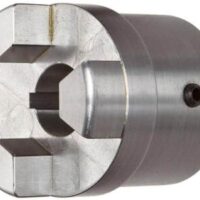


Lovejoy LF1 Torsional Coupling Base Element with Hardware.
Lovejoy 68514422434 LF1 Torsional Coupling Base Element with Hardware, High Temperature Rubber, 60A Shore Hardness, 90 in-lbs Nominal Torque.
Performance Data
Normal Temperature Range | -40 to 194 ºF |
Nominal Torque | 90.00 in·lb 10.00 N·m |
Max. Torque | 200.00 in·lb 25.00 N·m |
Allowable Continuous Vibratory Torque | 44.00 in·lb 5.00 N·m |
Max. Speed | 10000 rpm |
Max. Angular Misalignment | 3.00 º |
Max. Parallel Misalignment | 0.060 in 1.50 mm |
Wind-Up Angle at Nominal Torque | 6.00 º |
Wind-Up Angle at Max. Torque | 17.00 º |
Dynamic Torsional Stiffness | 140.00 Nm/rad |
Dynamic Torsional Stiffness | 1240.00 in·lb/rad |
Static Angular Stiffness | 2.66 in·lb/deg 0.30 Nm/deg |
Static Axial Stiffness | 220.00 lb/in 38.00 Nm/deg |
Static Radial Stiffness | 860.00 lb/in 150.00 Nm/deg |
Shore Hardness | 60A |
Torsional Element Specifications
Torsional Element Specifications |
|
This Lovejoy elastomer torsional coupling base element replaces the base element on Lovejoy LF series torsional coupling assemblies. It is made of high temperature rubber (HTR) for transferring and absorbing shock load and reducing wear on both shafts, and it can flex up to three degrees to compensate for angular misalignment.
This coupling is electrically isolating to prevent electrical arcing and circuit shortages and attaches to a flanged hub, flywheel adapter plate, or flywheel on the engine side and a cylindrical hub on the driven equipment side. Lovejoy LF series torsional couplings are suitable for use in various applications such as generators, compressors, pumps, blowers, fans, and other industrial driven equipment connecting to either the engine flywheel or a power take-off (PTO), among others.
Flexible couplings are used to link two rotating shafts that are not aligned in order to transmit the rotational power, known as torque, from one shaft to the other. Most flexible couplings consist of two hubs and a middle assembly; each hub attaches to a shaft while the middle assembly flexes between the hubs to accommodate the misalignment of the two shafts. Shaft misalignments are generally either parallel or angular and cause complications to transmitting rotational power from one shaft to another in the form of stresses, loads, vibrations, and other forces, which vary from one type of misalignment to another.
Flexible couplings are used in a broad range of applications, such as in motor vehicles, conveyors, escalators, agricultural, forestry and mining equipment, aeronautics, robotics and space exploration, among others. Lovejoy manufactures flexible couplings, universal joints, variable speed drives and various other transmission and mechanical power products. Their products meet the standards of the International Organization for Standardization (ISO), the Deutsches Institut für Normung (DIN), the American National Standards Institute (ANSI), the American Gear Manufacturers Association (AGMA), the Society of Automotive Engineers (SAE) and Japanese Industrial Standards (JIS) for quality assurance. The company, founded in 1900, is based in Downers Grove, IL.