Jaw Coupling Spider Materials Compared: Polyurethane vs Hytrel vs Bronze vs NBR
Table of Contents
The spider is the part of a jaw coupling that actually wears out — and the material it’s made from determines how much torque it can handle, how hot it can run, and how long it lasts before you’re replacing it again. Polyurethane, Hytrel, bronze, and NBR (nitrile) rubber are the four spider materials you’ll run into most often, and picking the wrong one for your application is one of the most common (and cheapest to avoid) mistakes in coupling selection.
Jaw Coupling Spider Materials Compared: Polyurethane vs Hytrel vs Bronze vs NBR:
Why the Spider Material Matters
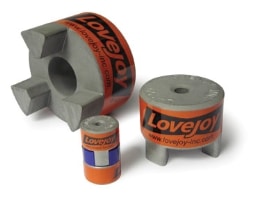
A jaw coupling transmits torque from the driving hub to the driven hub through the spider’s lobes, which sit compressed between the hubs’ interlocking jaws. Because the spider is the only flexible element in the assembly, it’s doing three jobs at once: transmitting torque, absorbing shock and vibration, and accommodating a small amount of shaft misalignment. Different elastomer and metal materials trade these properties off differently — a material that’s great for shock absorption isn’t necessarily the one you want for high-temperature or high-torque duty.
Polyurethane
Polyurethane is the general-purpose upgrade from standard rubber — it handles higher torque than NBR at a similar size, resists oil and most industrial chemicals better than rubber, and holds up well across a wide temperature range. It’s a common choice when you want better durability than NBR without stepping up to Hytrel or bronze pricing.
Best for: Pumps, compressors, and general industrial machinery where moderate-to-higher torque and some chemical exposure are expected, but extreme temperatures aren’t a factor.
Example: Lovejoy-style L095 urethane spider insert — Check Current Price on Amazon
Hytrel
Hytrel is a thermoplastic polyester elastomer, and it’s the material to reach for when torque capacity and temperature range both matter. Hytrel spiders carry significantly higher nominal torque ratings than NBR or standard polyurethane at the same coupling size — for example, a Lovejoy L225 Hytrel spider is rated around 6,228 in-lbs nominal torque, versus roughly 1,728 in-lbs for an L190 NBR spider at a smaller size. Hytrel also tolerates a wider temperature range than rubber, making it a common choice in demanding industrial and outdoor equipment.
Best for: Higher-torque industrial applications, equipment exposed to temperature swings, and situations where a rubber spider has failed prematurely from heat or load.
Examples:
- Lovejoy L070 Hytrel spider, 114 in-lbs nominal torque — Check Current Price on Amazon
- Lovejoy L150 Hytrel spider, 3,708 in-lbs nominal torque — Check Current Price on Amazon
- Lovejoy L225 Hytrel spider, 6,228 in-lbs nominal torque — Check Current Price on Amazon
Bronze
Bronze is the outlier on this list — it’s a rigid metal insert rather than an elastomer, used when the application runs too hot or too chemically aggressive for any elastomeric spider to survive. Because bronze doesn’t flex the way rubber or Hytrel does, a bronze-spider jaw coupling has essentially no shock-absorbing capacity and a much tighter misalignment tolerance. It’s a specialty choice, not a default upgrade.
Best for: High-temperature environments (ovens, kilns, foundries) or chemical exposure that would degrade any elastomer quickly — not for applications where shock absorption is the priority.
Examples:
- Lovejoy L/AL090-095 bronze spider — Check Current Price on Amazon
- Lovejoy L/AL110 bronze spider — Check Current Price on Amazon
- Lovejoy L190 bronze spider — Check Current Price on Amazon
NBR (Nitrile) Rubber
NBR rubber is the entry-level, lowest-cost spider material, and for a large share of general-duty applications it’s entirely sufficient. It handles moderate torque and vibration damping well and is the most common factory-fit spider material on new couplings. Its limitations show up at higher torque loads and elevated temperatures, where it wears faster than polyurethane or Hytrel.
Best for: General-duty, moderate-load applications — light pumps, fans, and machinery where cost matters more than maximum torque headroom or temperature extremes.
Examples:
- Lovejoy L070 NBR spider, 43.2 in-lbs nominal torque — Check Current Price on Amazon
- Lovejoy L099/L100 NBR spider — Check Current Price on Amazon
- Lovejoy L190 NBR spider, 1,728 in-lbs nominal torque — Check Current Price on Amazon
Quick Comparison
| Material | Relative Torque Capacity | Temperature Tolerance | Shock Absorption | Typical Cost |
|---|---|---|---|---|
| NBR Rubber | Low–Moderate | Moderate | Good | Lowest |
| Polyurethane | Moderate–High | Wide | Good | Moderate |
| Hytrel | High | Widest (elastomer) | Moderate | Higher |
| Bronze | High (rigid) | Highest | Minimal | Highest |
What to Check Before You Buy
Match the spider material to your application’s peak torque, not average load — a spider sized for average running torque will fail early under repeated peak loads. Confirm your operating temperature range against the material’s rated limits, especially if the equipment sits outdoors or near a heat source. And don’t assume every brand’s spider at a given size carries the same torque rating across materials — always check the specific nominal torque figure for the exact material and size you’re ordering, since it varies more than people expect.
Shop Jaw Coupling Spiders and Alternatives
Twin Spring Coupling stocks genuine Lovejoy spiders across all four materials, plus our own maintenance-free jaw coupling alternatives for applications where spider replacement isn’t something you want to deal with at all. Browse the full range on our jaw coupling comparison page, see our Lovejoy coupling replacement options, or check a specific spider:
- Lovejoy/Martin L095 NBR Spider Insert (4-Pack) — on Twin Spring Coupling
- Martin SHL190 Hytrel Spider — on Twin Spring Coupling
- Lovejoy L-AL075 Urethane Jaw Coupling Elastomer — on Twin Spring Coupling
Prices and availability shown on Amazon are accurate as of the date/time you check the listing and are subject to change — always confirm the current price on Amazon before purchase.
FAQ
Can I upgrade from NBR to Hytrel on the same hubs?
Usually yes, as long as the Hytrel spider is made for the same size and jaw geometry as your existing hubs. Confirm the spider’s dimensions match before ordering — an upgrade in material doesn’t help if the spider doesn’t fit your jaws correctly.
Why would I choose bronze over Hytrel if Hytrel handles more shock?
Bronze exists for conditions elastomers can’t survive at all — sustained high heat or aggressive chemical exposure. If your application runs within a normal industrial temperature range, an elastomeric spider (Hytrel or polyurethane) will almost always outperform bronze for typical use.
Does spider material affect misalignment tolerance?
Yes — softer elastomers like NBR and polyurethane tolerate slightly more misalignment than stiffer Hytrel, and bronze tolerates the least of all. None of them are meant to correct a poorly aligned shaft; they only accommodate small amounts of normal operating misalignment.