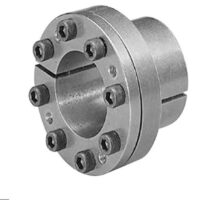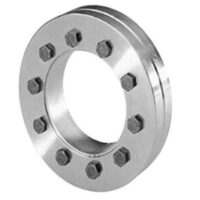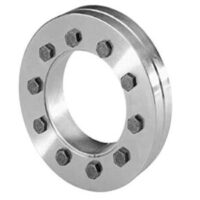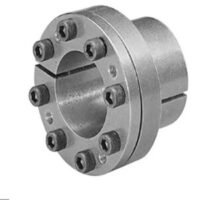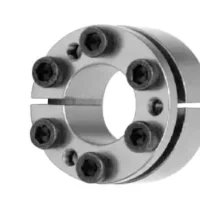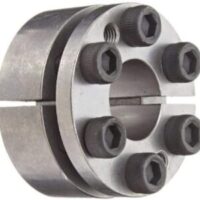


Lovejoy 2600 Series Shaft Locking Device 75 mm shaft diameter
Lovejoy 69790497944 2600 Series Shaft Locking Device, Metric, 75 mm shaft diameter x 115mm outer diameter of shaft locking device, 8112 ft-lb Maximum Transmissible Torque.
Dimensional Data.
Shaft Size | 75 x 115 mm |
Hub Outside Diameter (Dimension d) | 2.953 in 75.00 mm |
Tolerance of Shaft (T1) | +0 -0.0018 in |
Shaft Locking Device Outside Diameter (Dimension D) | 4.528 in 115 mm |
Tolerance of Hub Bore (T2) | -0 +0.0021 in |
Thrust Rings Width at Relaxed State (Dimension B) | 3.071 in 78.00 mm |
Locking Screw Size (Dimension T) | M10 |
Contact Length (Dimension l) | 2.756 in 70.00 mm |
Total Width at Relaxed State (Dimension L) | 3.465 in 88.01 mm |
Cubic inches | 71.04215 in³ 1804.47052 mm³ |
Performance Data.
Max. Transmissible Axial Force | 70646.00 lbf |
Max. Transmissible Torque | 8112.00 ft·lb |
Screw Tightening Torque | 61.20 ft·lb |
Pressure on The Hub | 15575.00 psi |
Pressure on The Shaft | 29852.00 psi |
This Lovejoy SLD 2600 Series metric internal shaft locking device connects a hub to a shaft in power transmission applications. Screw tension is converted into radial pressure to create an interference fit for zero backlash and high contact pressure for transmitting greater torque. It is self-centering for even, concentric tightening.
It expands to fill the gap between shaft and hub for easy installation and removal, and the friction fit eliminates damage to the shaft caused by hub movement. This high-torque shaft locking device is suitable for use with industrial sewing machines, fans, speed reducers, and turbine rotors, among others. Shaft collars are ring-shaped devices primarily used to secure components onto shafts.
They also serve as locators, mechanical stops, and spacers between other components. The two basic types of shaft collars are clamping (or split) collars, which come in one- or two-piece designs, and setscrew collars. In both types, one or more screws hold the collars in place on the shaft.
In setscrew collars, screws are tightened through the collar until they press directly against the shaft, and in clamping collars, screws are tightened to uniformly compress the collar around the shaft without impinging or marring it.
Whereas setscrew collars and one-piece clamping collars must be installed by sliding the collar over the end of the shaft, two-piece clamping collars separate into two halves and can be installed between components on the shaft. Shaft collars are made from a wide range of materials including zinc-plated steel, aluminum, nylon, and neoprene.
Found in nearly every type of machinery and industry, shaft collars are used in applications including gearbox assemblies, motor bases, machine tools, drive shafts, agricultural implements, medical equipment, and paper and steel mill equipment.
Lovejoy manufactures flexible couplings, universal joints, variable speed drives, and other transmission and mechanical power products. The company, founded in 1900, is headquartered in Downers Grove, IL.